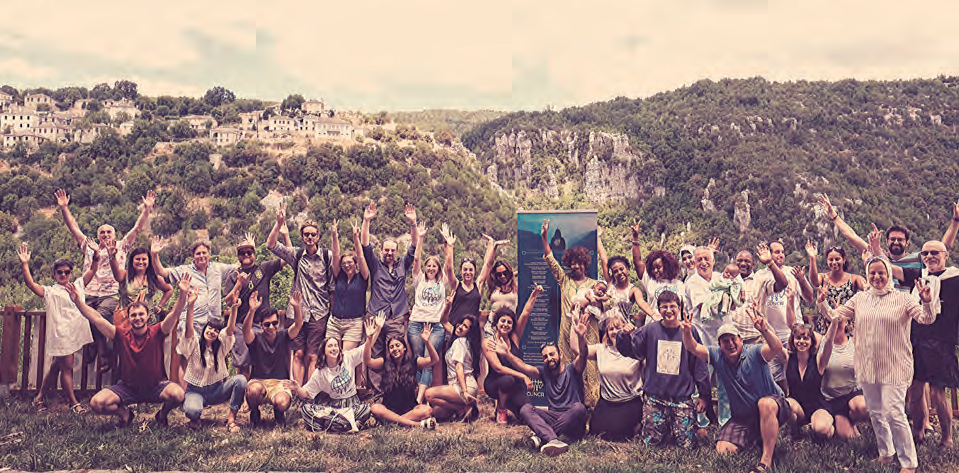
“The sea is rising, and so are we!” chanted some climate ambassadors as we boarded the ferry to Epirus this summer. After a week in Brussels and Corfu, we were ready to establish a global village at Vitsa, Greece. The global village was the site of the Center for United Nations Constitutional Research (CUNCR) 2019 Climate Justice & Democracy Summit. Youth activists from all continents and the Great Island States brought briefings in international environmental law, human rights, sovereignty, and global governance to bear in the mountain village during deliberations on issues in climate democracy.
At the Summit support for rights of the environment was palpable and is called for in the Epirus Declaration for Climate Democracy, co-authored in the shade of a Plane Tree planted at the center of the square. It also calls for intergenerational justice, global democratic solutions to help address the climate crisis, action to uphold the San Francisco Promise, and a focus on global security.
The Epirus Declaration’s call for rights of the environment draws inspiration from Anishinabek Nation Chief Water Commissioner Autumn Peltier who in 2018 said at the United Nations: “Our water deserves to be treated as human with human rights.” Peltier’s words echo the sentiments expressed by CUNCR Youth Climate Ambassadors Joyce Najm Mendes and Hanna Cordeiro, who have encouraged me to learn about Sumac Kawsay or buen vivir.
Philosopher and sociologist Raúl Prada Alcoreza describes buen vivir as “satisfaction in achieving the ideal of the community by feeding and nourishing itself through its own production.” Buen vivir is oriented more towards sustenance than accumulation. “Not just nutrition in the sense of food consumption,” he continues, “but through the equilibrium between the living forces of Nature and the commonwealth of the community.” These principles appear in the Bolivian and Ecuadorian constitutions.
Climate justice requires rapid decarbonization for a livable future and new relations to address inequity.
I make my home in Musqueam, Squamish, and Tsleil Waututh homelands British Columbia and the Province of British Columbia has just introduced legislation to uphold the United Nations Declaration on the Rights of Indigenous People. This law ensures Indigenous people are part of decision-making.
In the Centre for International Governance Innovation’s Special Report UNDRIP Implementation: Braiding International, Domestic and Indigenous Laws, Brenda Gunn writes: “At the international level, UNDRIP is necessary in part due to the failure of the general, existing human rights regimes to afford appropriate protection for Indigenous peoples’ rights.”
If human rights alone do not appropriately reflect the rights of Indigenous peoples, in part because many have been slow to respect Indigenous land rights, then legislating Indigenous rights and rights of the environment are ways to promote constructive relationships among peoples and with the environment. This has implications for development.
Latin American Center for Social Ecology Senior Research Eduardo Gudynas writes:
“Buen vivir will not stop building bridges, and will not reject the use of Western physics and engineering to build them, but the ones that it will propose may well have different sizes and materials, will be placed in other locations, and certainly will serve local and regional needs and not the needs of global markets.”
Climate change currently impacts water security and will continue to do as even as we work to keep global average temperature increase to within 1.5⁰ Celsius this century. “We need to acknowledge our waters with personhood so we can protect our waters,” Peltier reminds us . Consider the challenges that can accompany water scarcity.
Climate justice requires rapid decarbonization for a livable future and new relations to address inequity. Decarbonization helps us mitigate the worst impacts of climate change and new relations help ensure fairness in environmental resource access, use, and development or development alternatives.
The youth who trained with CUNCR this summer came to the program as climate leaders. We continue to work as Youth Climate Ambassadors, building support for intergenerational justice and global democratic, complimentary governance to help address the climate crisis.
Christine Leclerc is an award-winning author, aspiring climate scientist, and associate with the Center for United Nations Constitutional Research’s Youth Climate Ambassador Program. Sign on to the Epirus Declaration for Climate Democracy today at: http://tiny.cc/climatedemocracy.