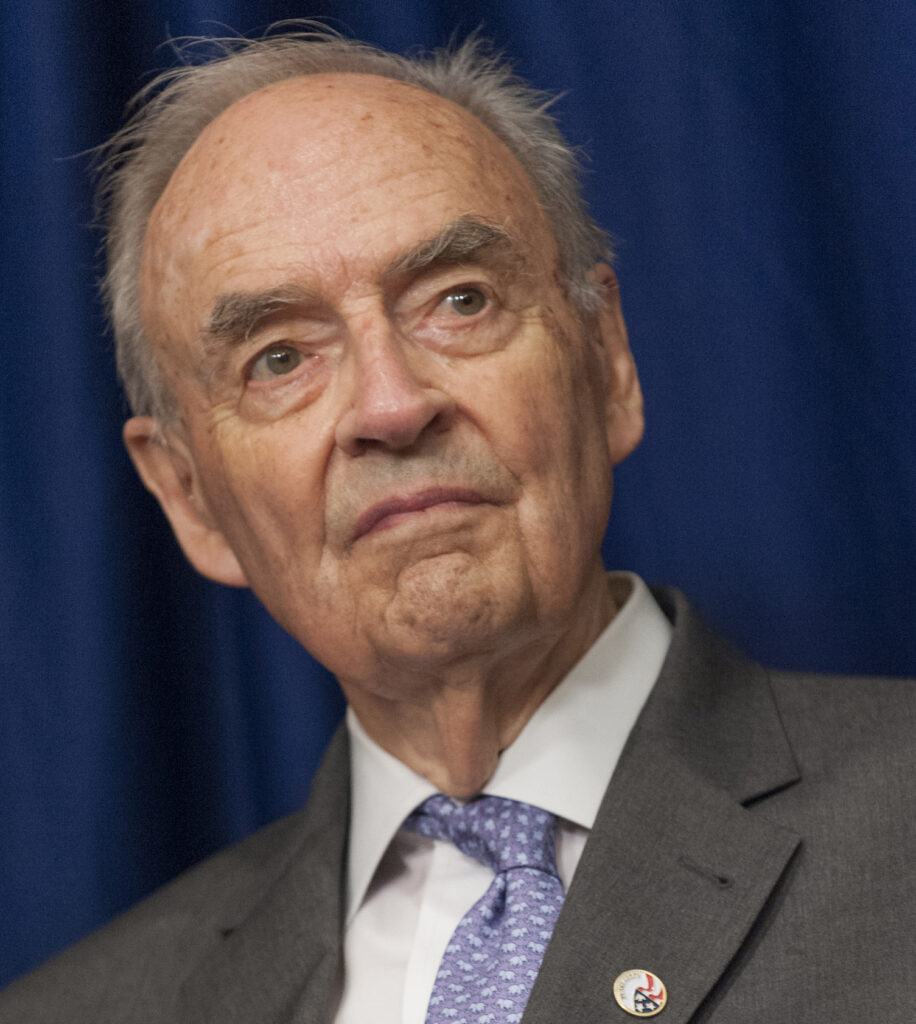
Obituaries for Harris Wofford Jr., who died on January 21 at age 92, focused on his work as an aide to John F. Kennedy, his brief tenure as a U.S. senator, and his lifetime engagement with both civil rights and volunteer service. But it may turn out that his greatest legacy was what Harris told me was “his first love in the world of ideas,” and the first great cause of his life. In 1942, during the darkest days of the Second World War, teenage Harris Wofford founded a nationwide youth movement which proclaimed that after the end of that war the human race could abolish war, by creating a “United States of the World.”
The 1940s Student Movement for a World Republic
I met Harris seven years ago, in January 2012 at a small event in Washington D.C. I approached him afterwards and asked him if he still believed any of that stuff. “It’s totally still how I think about the direction of history,” he replied. “And in maybe 25 years. … you’re the first one to ask me anything about it.”
One night early in 1941, Harris told me, as World War II raged prior to America’s entry, he was sitting in the bathtub in his family’s home in Scarsdale, New York, listening to a radio panel arguing for “A World Federal Union of Free Men.” Wofford later wrote that “prophets and visionary statesmen had proclaimed the idea of a Federal World Republic for centuries. … But for me the idea was born that night.”
And he demonstrated his enduring commitment to the dream of a politically unified human race.
A year later, Pearl Harbor had brought America into the war, and that moved 15-year-old Harris to act. One evening early in 1942, he and classmate Mary Ellen Purdy set out on their bicycles, rode around Scarsdale, knocked on doors, missed their suppers — but enlisted themselves and eight other classmates as the inaugural chapter of the “Student Federalists.”
The Student Federalists began to spread far beyond the boundaries of Scarsdale. Funds were raised. Speaking tours were organized. Literature was printed. Essay contests were launched. A “Model World Constitutional Convention” was undertaken just a few weeks before D-Day. TIME magazine published a flattering article on the organization’s founder on November 20, 1944. During one cycle, the National Debate Tournament topic for all American high schools was: “RESOLVED: That a federal world government should be established.” The chancellor of the University of Chicago, Robert Maynard Hutchins, assembled a group of eminent scholars and designated them “The Committee to Frame a World Constitution.” (Harris, by then an undergraduate at that university, served as advisor and chief bottle-washer for the Committee.) And the group at Northwestern University, comprised almost entirely of WWII veterans, pulled off a standing-room-only rally in Chicago Stadium, with Albert Einstein as keynote speaker.
By 1947, the Student Federalists had enlisted several thousand members, had opened 10 regional offices, and had established chapters on 367 high school and college campuses around the country. In February of that year, they combined with a half-dozen similarly thriving world government advocacy organizations to form the “United World Federalists” (UWF). One of the leading brokers of the merger, by all accounts, was 21-year-old Harris Wofford. That organization has remained in continuous existence ever since — small, obscure, struggling, but endeavoring to keep the flame alive — and is known today as Citizens for Global Solutions (CGS).
A Brilliant Young Man’s Thinking About a World Republic
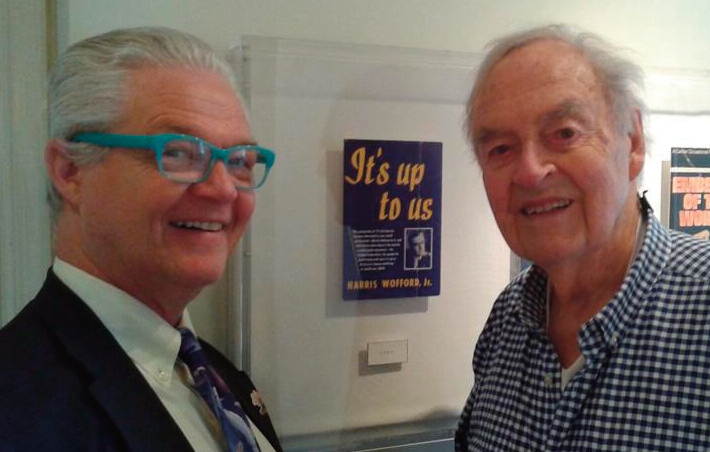
In 1946 at age 19, Wofford wrote “It’s Up to Us: Federal World Government in Our Time,” and followed up two years later with “Road to the World Republic.” With the new United Nations only a few months old, Harris illuminated both its impotence and undemocratic character. “We should work to develop the General Assembly into a world law-making body by delegating it real powers. … Assembly delegates should be elected directly by the people of the respective nations.”
Wofford emphasized the bedrock idea that world government would not eliminate local institutions or identities. “By becoming a world citizen, we maintain citizenship in our city, province, and nation, and gain a higher and more precious title. … This means a world government that is federal, with power in all fields truly international in scope but with lower levels each continuing in the fields it can govern best. … Only such a federal union can protect the diversity in the world and still secure the needed unity.”
Every time we got together, I could tell that it meant a great deal to Harris that one person during the twilight of his life knew something about and asked him about and cared about his opening act on the stage of history. And he demonstrated his enduring commitment to the dream of a politically unified human race. We coauthored two articles about it for the Huffington Post and the Public Interest Report from the Federation of American Scientists. We worked on them together for weeks, and at age 88 he haggled with me over every word. And just about a year ago, he re-engaged with the organization he did so much to create, Citizens for Global Solutions, joining its Advisory Council, endorsing the organization’s newly reconceptualized mission statement, committing to “a democratic federation of nations with the power to enact enforceable world law to abolish war, protect universal human rights, and restore and sustain our global environment.”