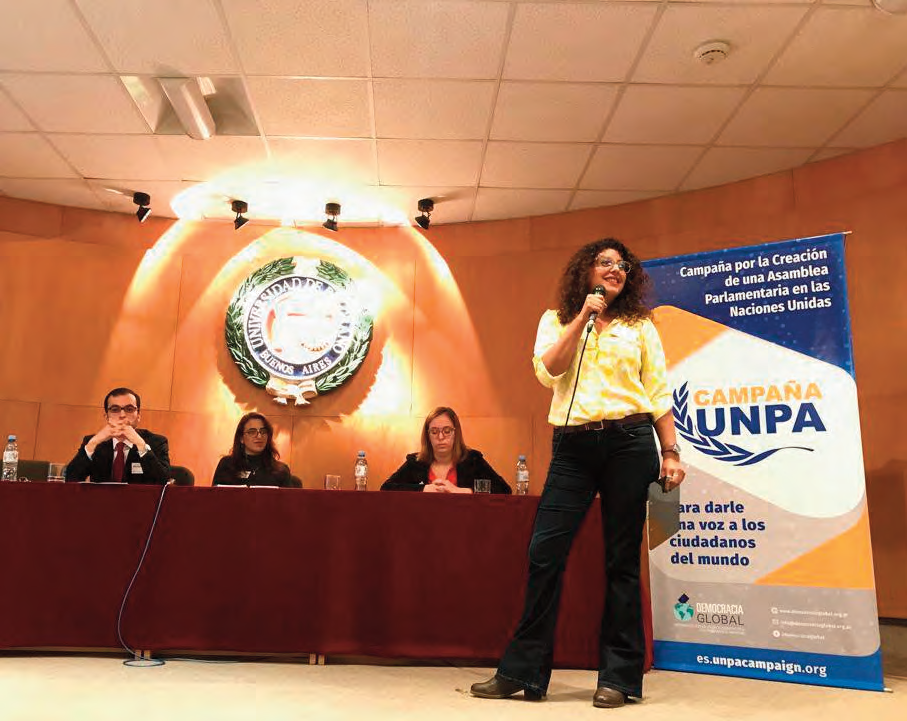
During the month of August 2019, an Argentinian NGO, Democracia Global, carried out a Model Parliamentary Assembly of the United Nations, the first in Latin America and one of the first globally. The Model, aimed at university students in Buenos Aires, sought to simulate the functioning of a Parliamentary Assembly at the United Nations, with its members representing the citizens of the world. From this forum we seek to highlight two central ideas: that of the Parliamentary Assembly within the United Nations and that of global citizenship.
First, there is a clear need to create a body composed of representatives democratically elected by the citizens of each State, to give global solutions to global problems such as environmental preservation, terrorism, and the unequal distribution of resources. In turn, as a result of becoming aware of this, the importance of the second concept, global citizenship, becomes obvious. Global citizenship seeks to lay the foundations for creating citizens who share a common understanding of a globally interconnected world with an urgency and need to solve the problems that concern us all. The Model UNPA sought to give an idea of these premises, raising awareness about current issues at the global level and their interactions with the local and regional environment, and highlighting the importance of international bodies to solve global problems.
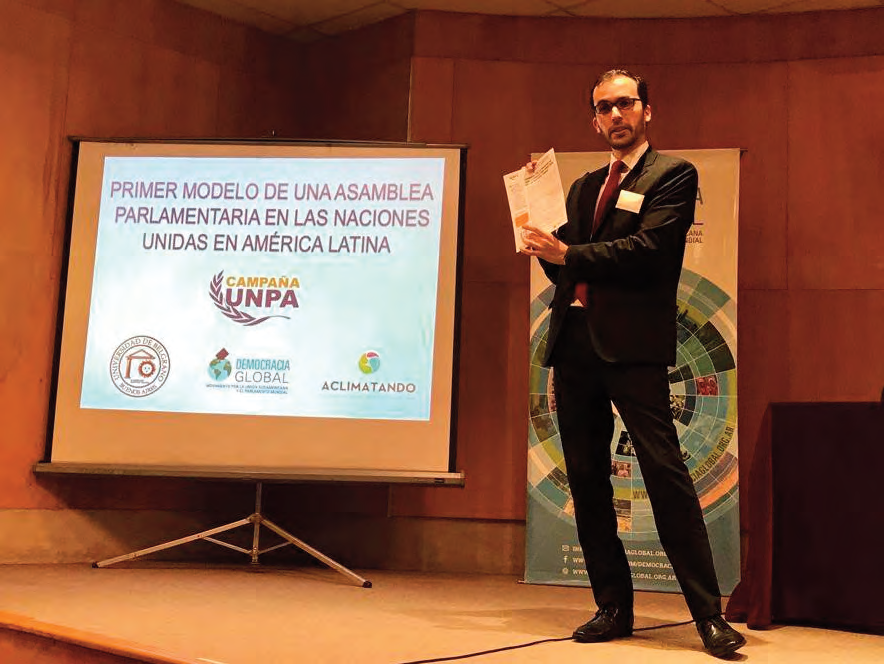
In pursuit of these ideas, two approaches were used, through which the key concepts of the activity were presented: the concept of global citizenship and the topic of debate: the care and preservation of the environment. The students were separated into groups of four and tasked with preparing a bill aimed at one of the four parliamentary committees. On August 21, the first session of debate was held, with the Parliamentary Commissions meeting simultaneously at the University of Belgrano and the bills of each group discussed. The four commissions were Economy and Finance, Ecosystem Preservation, Justice and Human Rights, and Education for Sustainable Development. Each commission was made up of a President, Vice President, and Coordinators. The role of the Presidents was occupied by national deputies and a United Nations consultant. Each working group was composed of a spokesperson, two advisors and a press representative. The projects under discussion proposed the creation of a Global Fund for Energy Transition in production and transport (Economy and Finance Commission); the reduction of the use of glyphosate in the agricultural industry (Justice and Human Rights Commission).
Global citizenship seeks to lay the foundations for creating citizens who share a common understanding of a globally interconnected world with an urgency and need to solve the problems that concern us all.
During the committee discussions, the presentation, discussion, and voting of each of the projects was carried out. The most popular project of each commission, as determined by vote, went to the final debate: a session of the Parliamentary Assembly, in the Schools (Education Commission for Sustainable Development); and the preservation of native forests (Ecosystem Preservation Commission). The Assembly sanctioned this last bill with force of law, at the premises of the Honorable Senate of the Argentine Nation. The session was chaired by Federico Pinedo, provisional president of the Senate; Esteban Bullrich, national senator; Fernando Iglesias, national deputy and World Federalist Movement co-president; Cristian Gimenez Corte, parliamentary advisor and consultant to the United Nations; and Rosendo Alsina, Director of Bilateral Relations of the General Directorate of International Relations.
During these meetings, fruitful and interesting debates were held on urgent global issues. The students had the opportunity to live a unique experience in research, legislation, and debate. They were able to understand the importance of creating supranational structures to deal with current issues globally, and knew how to interpret and recognize the concept of Global Citizenship to overcome obstacles and reach a common point. The development of future Models at national, regional, and global levels is key to developing educational initiatives based on the premise of belonging to a global community with common issues and problems.
In early November, Andreas Bummel, Executive Director, Democracy Without Borders, held a meeting in New York for governments and civil society organizations to discuss the UNPA and the World Citizens’ Initiative (WCI). The Canadian mission hosted the event; ten governments were represented. The World Citizen’s Initiative is a global civic participation campaign that would allow citizen- launched initiatives to be addressed by UN bodies such as the General Assembly or the Security Council, with the initiative’s representatives directly making their case. Such an approach would strengthen the UN’s democratic legitimacy and give global citizens a way to feel more connected to the work of the United Nations. There are already similar mechanisms elsewhere. For example, the European Citizens’ Initiative, which was the first transnational direct democracy tool. It provides a model for how the WCI might work. The WCI proposal is complementary to other efforts to broaden participation and inclusion at the United Nations, such as the work to include major groups and civil society and the establishment of a United Nations Parliamentary Assembly. Both civil society organizations and individuals may join the campaign. UN75 was also discussed, as the 75th anniversary of the United Nations gives momentum to efforts such as WCI and UNPA to democratize the UN specifically and global governance more generally. The WCI campaign was officially launched the following day with around fifty non-governmental organizations in attendance. So far, eighty NGOs have endorsed the campaign, along with television coverage and opinion pieces.