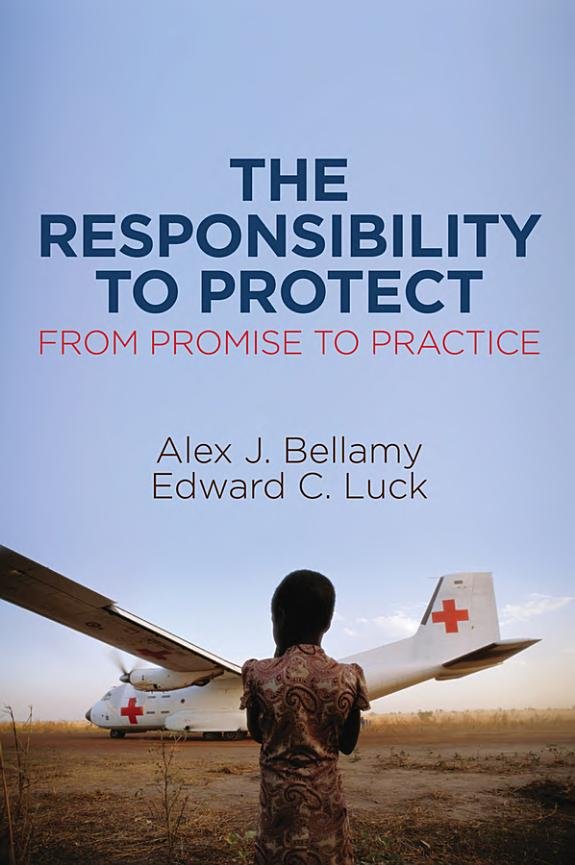
It has been over ten years since the international community adopted the principle of the Responsibility to Protect (R2P), “a political commitment to end the worst forms of violence and persecution. It seeks to narrow the gap between Member States’ pre-existing obligations under international humanitarian and human rights law and the reality faced by populations at risk of genocide, war crimes, ethnic cleansing and crimes against humanity” (United Nations). However, these pledges to support the R2P principle have failed or often been ignored. In The Responsibility to Protect: From Promise to Practice, Alex Bellamy and Edward Luck examine this question by looking past the United Nations and individual states and at the bigger picture of who is present when conflict-affected and other vulnerable populations are at risk. Bellamy, director of the Asia Pacific Centre for R2P and a professor at the University of Queensland, and Prof. Luck, former Special Adviser to the Secretary-General on the Responsibility to Protect and currently at the University of San Diego, are well placed to investigate what would be the best, next approach. In the end, Bellamy and Luck suggest that short-term policies to address emergency situations be combined with policies that will enable longer term change. These are the key to avoiding future crises of the sort we see currently in Syria and Libya.
December 2018
The Responsibility to Protect: From Promise to Practice by Bellamy and Luck
Alex Bellamy and Edward Luck examine the decade-long gap between international endorsement of the Responsibility to Protect principle and its repeated failures in cases such as Syria and Libya in The Responsibility to Protect: From Promise to Practice. Bellamy, director of the Asia Pacific Centre for R2P, and Luck, former UN Special Adviser on R2P, recommend combining short-term emergency policies with longer-term structural reforms to close that gap.
About this article
First published in Mondial, Vol. 2, Issue 2 (December 2018), US edition.
Mondial has been published in print twice a year since 2017 by Citizens for Global Solutions and World Federalist Movement – Canada.