
Most religious groups have responded to issues of violence and warfare by teaching their members either some form of pacifism (Jainism, Hinduism, Buddhism, Taoism, Christian peace churches) or some form of the just war tradition or military jihad (most monotheists). Such teachings have tried to either eliminate participation in wars or set strict limitations for the moral waging of war. But some religious groups and leaders have rejected the idea that warfare is a necessary part of human nature and human history. In order to eliminate the war system and solve humanity’s many global problems such as genocide, terrorism, violations of human rights, and environmental degradation due to global warming, some religious groups and leaders have advocated for the creation of a democratic world federal government that would create just world laws and prosecute individuals who violate them. Violent conflicts would be settled and global problems could be solved through a nonviolent democratic process. A world constitution would make explicit the powers and limitations of the world federation, the powers and limitations of national governments, and the rights and responsibilities of all citizens of the world.

According to the teachings of the prophet Baha’u’llah (1817-1892) and the Baha’i Universal House of Justice, acceptance of the oneness of humanity is a prerequisite for establishing a world federation. According to Baha’is, every national government will need to give up every claim to make war and should only maintain armaments for purposes of maintaining internal order. Baha’is and many others also believe that the facilitation of a world democracy would be enhanced by the universal use of a common auxiliary language (such as Esperanto) in addition to the national languages. For Baha’is, the creation of a world democracy would be a necessary condition for what Baha’u’llah called the “Most Great Peace,” the spiritual unification of our planet.
Roman Catholic bishops at the Second Vatican Council (1962-1965) called for outlawing war by international consent and creating a universal public authority that would safeguard security, justice, and human rights. In their encyclicals, Pope John XXIII, Pope Benedict XVI, and Pope Francis have stated that there is an urgent need for a true world political authority that would be regulated by law, observe the principles of subsidiarity and solidarity, promote human development, manage globalization, and establish the common good.
some religious groups and leaders have rejected the idea that warfare is a necessary part of human nature and human history.
Many individuals within religions that lack a central teaching authority have also promoted the goal of a world federation. For example, many liberal Protestant Christians and many Unitarian-Universalists are world federalists. Many people in other religions have emphasized the need for a global system of enforceable world laws instead of the current international system that is based on unenforceable treaties between nations. At the last Parliament of the World’s Religions in Toronto in 2018, the Hindu Swami Agnivesh said that instead of spending trillions of dollars on the war system, the peoples of the world need to unite and create a world parliament based on the Earth Constitution. He said that “without a world government, we cannot solve our major world problems.” Many Buddhists have been promoting Buddha’s goal of relieving suffering for all beings through love, compassion, and nonviolence. The Japanese Buddhist scholar Nikkyo Niwano has said that then the whole world will become one “Buddha-land” and that a world federation should be our blueprint for achieving this goal.
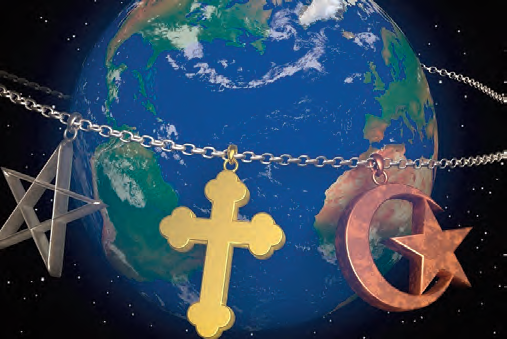
Before the legal and political superstructure of a democratic world federation can be formed, the world’s religions have the responsibility of building a firm foundation for it by emphasizing their versions of the Golden Rule, common ethical commandments, “humatriotism” (loyalty to the human family), world citizenship, and stewardship of creation. They need to be committed to interreligious dialogue and cooperation as well as act according to the principles of the Declaration of a Global Ethic and the Charter for Compassion that have been promoted at the Parliaments of the World’s Religions. The world’s religions need to teach that the nations of the world form an interdependent community which requires a global system of laws and security in order to survive.
David Oughton’s interdisciplinary doctorate is in “Philosophies and Theologies of Peace and Justice.” He teaches courses in the world’s religions at Saint Louis University. He is the President of Interfaith Partnership of Greater St. Louis. He serves on the national board of Citizens for Global Solutions.