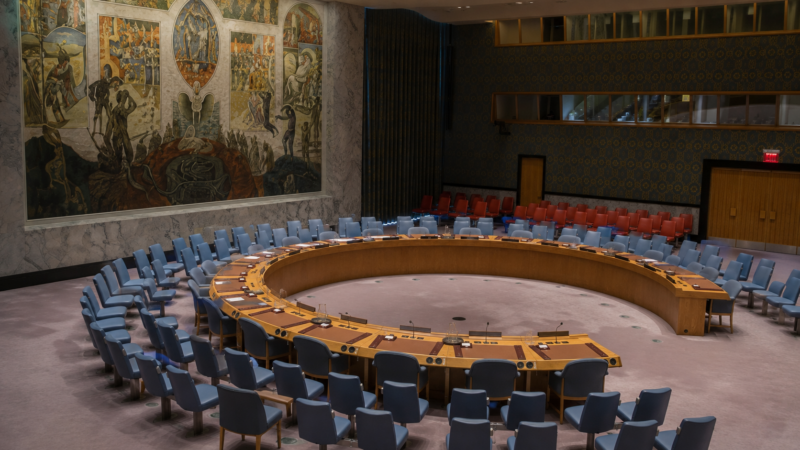
The true challenge of our time is to bring rules, law, and democracy to the chaos of international relations. If we want to overcome the existential threats of nuclear weapons and abolish war, we will need a world governing body that is more democratic and empowered to act than the current United Nations. The organized murder of one group of humans by another group of humans is called war. We live in a world where the vilest of crimes, which are punished with severe consequences within most societies, are somehow acceptable when committed as part of war. War has been an integral part of human history and, in the nuclear age, is the most imminent threat to our continued existence. As modern, civilized people, most of us find war abhorrent, but few of us call for the abolition of war or understand why war still exists in the contemporary world. War exists because human society has been organized around the concept of the in-group and the out-group. The in-group could be a tribe, city, nation, or group of nations. The out-group may be tolerated, but in many instances, it is considered the enemy. The question of our time is, can we create a new story where humanity is the in-group? Can we civilize a lawless world by creating a basic system of enforceable global law? Wars between countries continue because countries exist in relative anarchy at the international level. We have international law based on treaties that help maintain order, but this system is not an actual law, as it is voluntary. Valid law has consequences and enforcement mechanisms if one breaks the law. At the international level, we still live and die by the law of the jungle, which is “might makes right.” The countries of the European Union have found peace after thousands of years of warfare and two world wars by trading away a piece of sovereignty to form a collective. They now resolve disputes in the European Union’s parliament and courts. The world’s countries can find peace by building an international union of nations and creating a similar system of courts and a global parliament. The United Nations has a membership of almost all the countries on earth, and this in itself is an impressive accomplishment in that it creates an inclusive forum for discussion of international problems. Unfortunately, the UN lacks democratic standards and is flawed by its outdated design, and thus ineffective in addressing the major global security issues of our day. International security issues are dealt with in the UN by the Security Council and, in particular, the five permanent members who were the victors of World War II: the United States, the United Kingdom, France, the Russian Federation, and the People’s Republic of China. They each have a veto, allowing a single country to block the action called for by the majority. The General Assembly can pass resolutions, but they constitute no more than recommendations. The United Nations also suffers from a democratic deficit, as each member country has one vote regardless of population. We are at a critical moment in human history. International laws exist, but they are often not enforceable. Force and military might still rule the world in terms of global affairs. Fortunately, a US organization, Citizens for Global Solutions – like the World Federalist Movement, which brings together organizations with a similar orientation around the globe — works to create a world ruled by law rather than force to build the legal institutions necessary for peace and to abolish war. Citizens for Global Solutions is working to enhance the jurisdiction and use of the International Court of Justice to resolve disputes without violence in a campaign called Law, not War. The challenge of our time is to abolish war and create the global institutions of law necessary to resolve disputes through legal, rather than lethal means.
Mondial is the home of world federalist thought.
Can We Abolish War, or Will War Abolish Us?
Originally published by Citizens for Global Solutions · March 2025
War survives because nations live in near anarchy, where treaties are voluntary and might makes right. The European Union shows the way out: pooling some sovereignty into shared courts and a parliament, which a more democratic world body than the UN could do for everyone.
About this article
Originally published by Citizens for Global Solutions in March 2025. Read the original.
Founded in 1947 as the United World Federalists, Citizens for Global Solutions is a nonpartisan membership organisation based in Washington, DC. It works through advocacy, education and coalition building for enforceable world law and human rights, and co-publishes Mondial with World Federalist Movement – Canada.
Cite this article in MLA style
Tetalman, Jerry. “Can We Abolish War, or Will War Abolish Us?” Citizens for Global Solutions, Mar. 2025, https://globalsolutions.org/
Mondial by email: one article a month, free
Mondial is the home of world federalist thought: argument and analysis on global governance from across the movement.
Keep reading
-
Breaking the Cycle: The Pentalogue and the Permanent Minority Problem
Young World Federalists · October 2026
-
The World Peace Award: A Legacy of Peace Since 1972
World Federalist Movement – Canada · September 2026
-
Who Acts When the Security Council Cannot?
World Federalist Movement – Canada · July 2026